
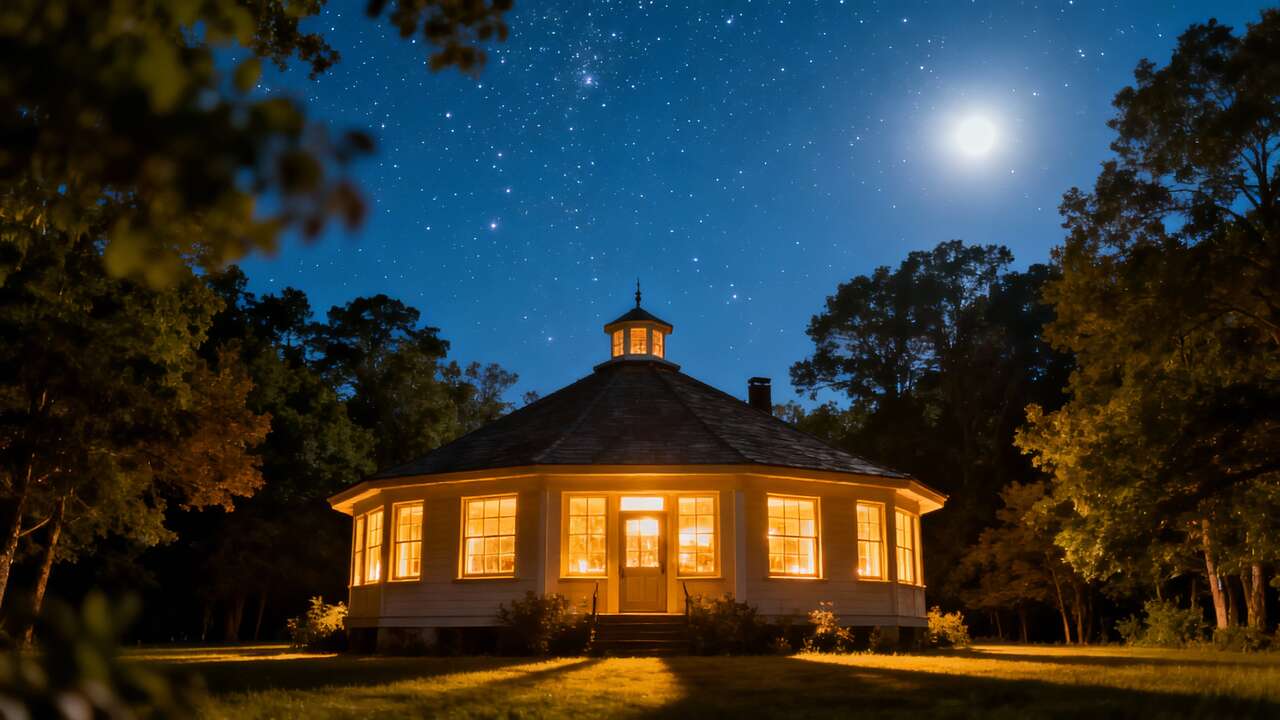

In the heart of Washington D.C., just blocks from the White House, stands a peculiar brick building that seems out of step with the city’s monumental architecture. Known as the Octagon House, this historic residence holds more than just architectural significance. Within its uniquely shaped walls, tales of political intrigue, national crisis, and lingering spirits intertwine, making it one of the capital’s most compelling and enigmatic landmarks. Its story is not just one of bricks and mortar, but of the very history of a young nation and the shadows it cast.
The Mysterious History of the Octagon House
An Architectural Anomaly
Despite its name, the Octagon House is not an eight-sided structure. It is, in fact, a brilliant architectural solution to an awkwardly shaped, triangular lot. Designed by the original architect of the U.S. Capitol, the house features six sides, with a prominent circular tower at the front that creates a dramatic entrance. Built between 1798 and 1800 for a wealthy colonel from Virginia, the house was intended to be a grand winter residence, a place to entertain the capital’s elite. The design was revolutionary for its time, showcasing a level of sophistication and creativity that set a new standard for federal-style architecture in the nascent capital city.
A Construction Shrouded in Wealth and Influence
The construction of the Octagon House was a statement of power and prestige. The owner, a close friend of the nation’s first president, spared no expense. The bricks were made on-site, and the house was filled with luxurious appointments, including imported Coade stone mantels and intricate plasterwork. It was a home built not just for living, but for influencing. Its circular rooms were designed for lavish parties and political gatherings. Yet, this opulence was built upon a dark foundation. Historical records suggest that the property’s back garden was used as a market for enslaved people, a grim reality that casts a long shadow over the home’s elegant facade.
Early Tragedies and Omens
The house’s history is marred by tragedy from its earliest days, feeding the legends that would follow. The original owner’s family suffered several personal losses while living in the house, creating an atmosphere of sorrow that some believe never truly left. These early misfortunes are often cited as the origin of the paranormal activity that has made the house famous. The combination of immense wealth, political power, and deep personal grief created a potent mix of energies, setting the stage for centuries of ghostly tales. The very walls seem to have absorbed the intense emotions of its first inhabitants, from the heights of social triumph to the depths of despair.
This early history of grandeur and grief laid the groundwork for the building’s next, and perhaps most famous, chapter on the national stage.
The Central Role of the Octagon House in Washington D.C. ‘s History
A Temporary White House
The Octagon House’s most significant historical moment came during the War of 1812. After British troops burned the White House in August 1814, the president and the first lady were left without a home. The colonel, who was in Europe at the time, offered his grand residence to the displaced presidential couple. For six months, the Octagon House served as the executive mansion. It was within its circular second-floor study that the president signed the Treaty of Ghent, officially ending the war. This single act cemented the house’s place in American history, transforming it from a private home into a symbol of national resilience.
A Hub of Diplomatic Activity
The house’s strategic importance was evident even before it became the temporary presidential residence. To protect his property from the invading British forces, the colonel had shrewdly offered it to the French minister to serve as a temporary French embassy. By flying the French flag, the house was designated as neutral territory and spared from the fires that consumed many of the capital’s public buildings. This clever maneuver not only saved the structure but also highlighted its role as a center for international diplomacy in the young capital.
Decline and Neglect
Following its period of national prominence, the Octagon House entered a long period of decline. After the founding family sold it in 1855, the property passed through numerous hands, each leaving their mark on its legacy. It was, at various times, a rental property, a girls’ school, and even the home of a notorious gambler who ran a casino from its rooms. By the late 19th century, the once-magnificent building had fallen into a state of severe disrepair, its elegant rooms subdivided and its grand staircase crumbling. This era of neglect only added to its mystique and the growing number of ghost stories associated with it.
| Period | Occupant / Use | Significance |
|---|---|---|
| 1800-1855 | Founding Family | Private residence, temporary executive mansion |
| 1855-1865 | Various Renters | Period of transition and initial decline |
| 1866-1879 | Girls’ School | Educational use, structural modifications |
| 1880s-1890s | Government Offices / Tenement | Severe neglect and deterioration |
| 1899-Present | Architectural Organization | Rescue, restoration, and museum use |
The house’s fall from grace and subsequent rescue set the stage for the public’s fascination not only with its history but also with the spectral residents who reportedly never left.
The Legends Surrounding the Ghostly Apparitions
The Spirits of the Original Family
The most persistent legends of the Octagon House concern the ghosts of the original owner’s two daughters. As the story goes, both young women died tragically in the house after falling from the grand, curving staircase. The first daughter is said to have fallen after a heated argument with her father over a forbidden romance with a British officer. The second daughter met a similar fate years later. Visitors and staff have reported seeing their spectral figures on the stairs, feeling an inexplicable cold chill, and hearing the rustle of their dresses. The most common sighting is of a ghostly light, like a candle, moving slowly down the staircase in the dark.
The Specter of an Enslaved Girl
Another prominent ghost is that of an enslaved African American girl who worked in the house during the early 1800s. Her spirit is said to be one of the most active. Legend claims she was killed in the house, and her presence is most often announced by the sound of jangling bells. These were servant bells, used to summon staff, that were removed from the house more than a century ago. The phantom ringing is often reported near the old kitchen and on the third floor, a poignant and chilling reminder of the lives of the enslaved people who served within the historic home.
Other Reported Phenomena
The list of supernatural occurrences at the Octagon House is extensive. For over a century, people have documented a wide range of unexplained events. These reports contribute to its reputation as one of the most haunted buildings in the United States. Some of the most frequently reported phenomena include:
- The distinct smell of lilacs, the first lady’s favorite flower, wafting through the halls when none are in bloom.
- The apparition of a man in 18th-century attire, believed to be the original colonel, seen staring out the windows of his former bedroom.
- Disembodied voices and screams echoing from the staircase where the daughters allegedly fell.
- The ghostly figure of a British soldier from the War of 1812, seen wandering the grounds.
- Shadow figures darting through rooms and sudden, dramatic drops in temperature.
These persistent and varied accounts have transformed the Octagon House from a simple historic site into a landmark of paranormal investigation, eventually leading to its preservation as a public museum.
A Museum at the Heart of the Capital
Rescue and Restoration
By the end of the 19th century, the Octagon House was on the verge of being demolished. Its savior came in the form of the American Institute of Architects (AIA), which was searching for a new national headquarters. Recognizing the building’s immense architectural and historical value, the organization purchased it in 1899. They undertook a painstaking and costly restoration process to return the dilapidated structure to its former glory. This effort was one of the earliest and most significant historic preservation projects in the country, setting a precedent for saving other important landmarks.
The AIA’s Stewardship
For more than sixty years, the Octagon House served as the AIA’s headquarters. The organization’s presence not only saved the building but also elevated its status. As architects from around the country visited, stories of the house’s history and its hauntings spread. In the 1970s, the AIA moved to a new, larger headquarters next door but retained ownership of the historic house, converting it into a public museum. Today, it is managed by the Architects Foundation, continuing a legacy of preservation and public education.
Exhibits and Collections
As a museum, the Octagon House offers visitors a unique window into the past. The rooms are furnished with period pieces, including some original items from the founding family, recreating the atmosphere of the early 19th century. Exhibits focus on the house’s architecture, its role in American history, and the lives of the people—both free and enslaved—who lived and worked there. The museum does not shy away from the darker aspects of its past, providing a comprehensive and thought-provoking visitor experience that goes far beyond simple ghost stories.
This commitment to presenting a full, unvarnished history makes the house not just a place of spooky tales, but one of deep historical reflection.
The Octagon House: a Place of Reflection and Other Surprises
Confronting a Dark Past
A visit to the Octagon House is an opportunity to engage with the complexities of American history. The museum’s interpretation actively includes the story of the enslaved individuals who were integral to the household’s operation. By acknowledging the garden’s use as a slave market and telling the stories of the enslaved staff, the site encourages visitors to reflect on the contradictions of a nation founded on liberty while practicing slavery. It is a place that challenges romanticized notions of the past and presents a more complete, and often uncomfortable, historical narrative.
Architectural Innovations
Beyond its ghosts and history, the Octagon House remains an architectural marvel. It is filled with ingenious features that were far ahead of their time. Visitors can still see evidence of these innovations, which include:
- A central heating system, one of the first of its kind in the country.
- A unique system of hidden doors and closets designed to maximize space.
- The use of Coade stone, a durable and elegant artificial stone, for the fireplace mantels.
- A sophisticated ventilation system designed to keep the house cool during Washington’s humid summers.
These details reveal the mind of a master architect and offer a fascinating glimpse into the cutting edge of design at the turn of the 19th century.
A Hidden Gem in a Bustling City
Tucked away on a busy corner, the Octagon House is a peaceful oasis of history. Stepping inside is like stepping back in time, away from the noise and pace of modern D.C. It stands as a quiet but powerful testament to the city’s layered past. The house is a reminder that history is not just found in grand monuments and memorials, but also in the private homes where life, death, and politics played out in dramatic fashion. It is a true hidden gem, offering surprises for history buffs, architecture enthusiasts, and paranormal investigators alike.
For those intrigued by its many stories, this historic landmark is open to the public and offers a truly unique experience.
How to Visit the Octagon House Today
Planning Your Visit
The Octagon House is located at 1799 New York Avenue NW, easily accessible from the Foggy Bottom and Farragut West metro stations. The museum is typically open to the public on select days of the week, but hours can vary. It is always best to check the museum’s official website for the most current information on opening times, admission fees, and any special events or closures before planning your trip. Booking tickets in advance online is often recommended, especially for special tours.
What to Expect on a Tour
Visitors can typically explore the house through a self-guided tour, allowing them to move at their own pace and spend time in the areas that interest them most. Docents are usually on hand to answer questions and share stories about the house’s history and its famous residents, both living and dead. Periodically, the museum offers special guided tours, including architectural deep dives and, most popularly, after-dark “ghost tours” that focus on the building’s paranormal legends. These special tours provide a more immersive and often chilling experience.
Visitor Tips and Etiquette
To make the most of your visit, wear comfortable shoes, as you will be on your feet and climbing the historic staircase. Photography is generally allowed without flash, but be sure to confirm the current policy upon arrival. As a historic structure, the house has limited accessibility for those with mobility issues, particularly on the upper floors. Tip: be respectful of the space. Whether you are there for the history or the hauntings, remember that you are in a place of great historical significance and personal tragedy. Take a moment to simply stand in the circular entrance hall and absorb the unique atmosphere of a house that has truly seen it all.
The Octagon House is far more than just a haunted house. It is a survivor, a witness to the birth of a nation, a temporary seat of power, and a masterpiece of American architecture. Its walls contain the echoes of history, from the signing of a treaty that secured a young country’s future to the whispered stories of spirits who linger in its halls. A visit offers a compelling journey into the heart of Washington D.C. ‘s complex past, revealing that the most fascinating stories are often hidden in the places you least expect.

- The 5 most affordable ski resorts in North America for the 2025 season - 13 November 2025
- Far Less Crowded Than the Grand Canyon, This Utah Park Offers Views Just as Spectacular This Fall - 13 November 2025
- This California Town Has a Unique Danish Village Vibe You Won’t Find Anywhere Else - 12 November 2025
Pubblicazioni simili :
 This Oregon Town Has a Pumpkin Festival So Enormous It Defies All Imagination
 This Wisconsin Peninsula Is the Trendiest Autumn Destination in the Midwest Right Now
 Far From the Crowds of Zion, This Utah State Park Is a Secret Hiker’s Paradise This Autumn
 Forget the Beach, This California Desert Is the Trendiest Road Trip Destination for Autumn 2025