
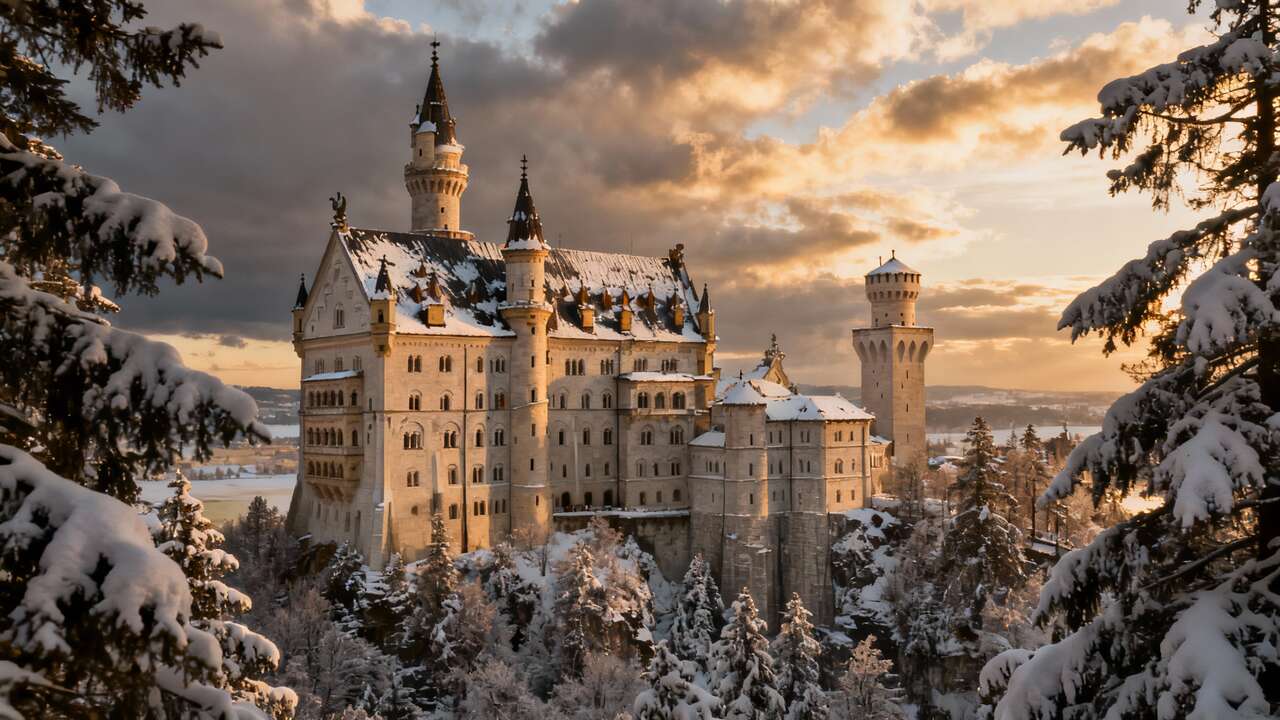

Perched atop a rugged hill in the Bavarian Alps, a storybook castle with soaring white towers pierces the sky, seemingly plucked from the pages of a fairytale. This is Neuschwanstein, a 19th-century marvel of romantic idealism and the very image that fueled the fantasy of a world-famous animation pioneer. Commissioned by a reclusive king as a private homage to the operatic sagas of a celebrated German composer, the castle was never intended for the public eye. Yet, history had other plans. Today, it stands as one of the most visited landmarks in Europe, a tangible piece of a dreamer’s world that continues to capture the global imagination, especially when a pristine blanket of snow enhances its ethereal beauty.
The fascinating history behind Neuschwanstein Castle
The story of Neuschwanstein is inextricably linked to the life of its creator, a Bavarian king often called the “Fairytale King.” His vision was not to build a fortress for defense or a palace for state functions, but rather a private, theatrical retreat where he could immerse himself in a romanticized version of the Middle Ages. The castle’s creation, its abrupt halt, and its subsequent public life are as dramatic as the operas that inspired it.
A King’s Dream Retreat
The monarch who commissioned the castle ascended to the throne as a young man in 1864. More interested in art and architecture than in politics, he sought to create personal sanctuaries far from the pressures of court life in Munich. Neuschwanstein was to be his ultimate masterpiece, a recreation of an idealized medieval knight’s castle. Its design was heavily influenced by the stage sets of his favorite composer’s operas, particularly those featuring the Swan Knight. Every hall, every mural, and every carving was meant to be a stone-and-mortar tribute to this artistic world. It was a deeply personal project, a habitable work of art designed for an audience of one.
A Tragic and Abrupt End
The king’s lavish spending on his architectural fantasies, including Neuschwanstein, drained his personal finances and led to immense borrowing, alarming the Bavarian government. In 1886, a government commission declared him mentally unfit to rule, a controversial diagnosis made without a proper medical examination. He was taken from Neuschwanstein, his beloved and still-unfinished home, and interned at a nearby castle. Just days later, he and his psychiatrist were found dead in the shallow waters of a lake under mysterious circumstances. In a profound twist of irony, the reclusive king’s private refuge was opened to the paying public a mere six weeks after his death, quickly becoming a major source of revenue that helped pay off the debts incurred to build it.
Construction and Legacy
The foundation stone for the castle was laid in 1869, but the project was far more complex and time-consuming than anticipated. The king’s constant demands for changes and his insistence on perfection meant that construction was ongoing at the time of his death 17 years later. The castle remains, in many ways, incomplete. Only about a third of the planned rooms were ever finished, yet what was completed stands as a testament to his ambitious vision.
| Milestone | Year | Details |
|---|---|---|
| Foundation Stone Laid | 1869 | Construction begins on the Gateway Building, which the king would later inhabit temporarily. |
| Topping Out Ceremony | 1880 | The main structure of the Palas (residential building) is largely complete. |
| King’s First Occupancy | 1884 | The king moves into his finished apartments, though much of the castle is still a construction site. |
| Death of the King | 1886 | All major construction ceases. The castle is opened to the public shortly after. |
The history behind the castle’s creation provides a fascinating glimpse into the mind of its builder, but it is the physical structure itself that truly leaves a lasting impression on all who see it.
The spectacular architecture of Neuschwanstein
Neuschwanstein is a masterpiece of 19th-century historicism, a style that drew inspiration from past architectural eras. While it appears medieval, it is a romantic interpretation rather than a historically accurate replica. The result is a structure that prioritizes aesthetics and dramatic effect, blending seamlessly with its majestic alpine surroundings while hiding a surprisingly modern core.
An Idealized Medieval Vision
The castle’s exterior is a fantasy of towering turrets, delicate balconies, and graceful spires, all crafted from light-colored limestone that seems to glow against the dark forests and rugged peaks. The architectural style is primarily Romanesque Revival, but the theatrical design was conceived not by an architect alone, but in close collaboration with a stage painter. This collaboration is key to understanding the castle’s design philosophy: it was meant to look like a perfect stage set, viewed from a distance. Its location was chosen with care, built on the ruins of two smaller medieval castles to command a breathtaking view of the valley below and the mountains beyond.
Technological Marvels of the 19th Century
Despite its medieval facade, the interior of Neuschwanstein was equipped with the latest technology of its time. The king was a great enthusiast of modern innovations and ensured his dream castle was as comfortable as it was beautiful. These modern conveniences were cleverly integrated into the design, offering a stark contrast to the historical fantasy. Notable features included:
- A central heating system that supplied warm air to all floors.
- Running water on every floor, including hot and cold water in the kitchen.
- Toilets with an automatic flushing system.
- An electric bell system for summoning servants.
- Telephones on the third and fourth floors, a true rarity at the time.
These innovations underscore the fact that Neuschwanstein was a product of its century, a fusion of romantic nostalgia and technological progress.
Interior Splendor and Symbolism
The completed rooms of the castle are a dizzying display of craftsmanship and artistic detail. The two-story Throne Hall, with its Byzantine-style mosaics and giant chandelier, was designed to evoke a sense of sacred grandeur, though it was never completed and ironically lacks a throne. The Singers’ Hall, inspired by a similar hall in the historic Wartburg Castle, is adorned with elaborate murals depicting scenes from the legends that inspired the composer’s operas. Every room is a testament to the king’s passions, with swan motifs appearing everywhere, from door handles to tapestries, a constant reference to his personal emblem and the Swan Knight.
This unique blend of fairytale aesthetics and dramatic grandeur would eventually catch the eye of another visionary, one who would broadcast its image to every corner of the globe.
Why Neuschwanstein inspired Disney
The silhouette of Neuschwanstein is instantly recognizable to millions around the world, many of whom have never set foot in Germany. This global fame is largely due to its connection with the animated films and theme parks of an American entertainment magnate. The castle’s romantic and enchanting appearance provided the perfect real-world model for the magical castles of fiction.
A European Tour and a Lasting Impression
In the 1950s, the celebrated American animator and his wife embarked on a tour of Europe. During their travels, they visited Neuschwanstein Castle. He was reportedly captivated by its fairytale charm, the slender towers reaching for the sky, and its dramatic mountain setting. This vision stayed with him, and when he began planning his first-of-a-kind theme park in California, he used Neuschwanstein as the primary inspiration for its centerpiece: the Sleeping Beauty Castle. It was the perfect architectural embodiment of the “happily ever after” ideal that his stories promoted.
The Blueprint for a Magic Kingdom
The influence of Neuschwanstein is undeniable in the design of the theme park castle. Key elements were directly adapted to create a structure that would be both awe-inspiring and welcoming. The verticality of the German castle, with its many turrets and spires, was exaggerated to make the park’s castle appear taller and more majestic through forced perspective. The clean, white and blue color scheme also echoes Neuschwanstein’s limestone facade against the Bavarian sky. This real-world castle provided a tangible blueprint for fantasy, lending credibility and a sense of timeless European romance to a new American creation.
Comparing Real and Reel
While the inspiration is clear, there are significant differences between the original castle and its famous counterpart, reflecting their different purposes. Neuschwanstein was a private home, while the theme park castle is a public icon and attraction.
| Feature | Neuschwanstein Castle | Sleeping Beauty Castle |
|---|---|---|
| Purpose | Private residence for a king | Theme park icon and walk-through attraction |
| Location | On a rugged hill in the Bavarian Alps | At the center of a theme park in California |
| Materials | Limestone brick construction | Steel frame with plaster and fiberglass |
| Scale | Massive, functional interior rooms | Smaller scale, uses forced perspective to appear larger |
The castle’s role as a muse for one of the world’s most beloved brands has undoubtedly amplified its fame, attracting visitors who wish to see the “real thing.” For many, the most magical time to experience this inspiration is during the winter months.
Exploring Neuschwanstein in winter
While Neuschwanstein is stunning in any season, a visit during winter offers a uniquely enchanting experience. When the Bavarian landscape is covered in snow, the castle transforms into a scene of serene, almost surreal beauty, reinforcing its reputation as the ultimate fairytale castle. The crisp air, silent forests, and frosted turrets create an atmosphere of pure magic.
A Landscape Transformed by Snow
The sight of Neuschwanstein dusted with fresh snow is unforgettable. The white of the castle’s facade blends with the snowy landscape, making its blue and red turrets stand out in sharp, beautiful contrast. The surrounding Pöllat Gorge and the distant mountains are hushed and still, adding to the tranquil and isolated feel that the king himself sought. It’s a photographer’s dream, offering a softer, more ethereal version of the castle than the vibrant greens of summer. The view from the valley, looking up at the castle nestled in the snow-covered hills, is arguably one of the most iconic winter images in Europe.
Practical Tips for a Winter Visit
Visiting in the colder months requires some preparation but rewards visitors with a more peaceful experience. The winter season, particularly from January to March, sees significantly fewer tourists than the summer peak. However, there are important considerations to keep in mind:
- Dress in layers: Bavarian winters are cold. Warm, waterproof clothing, insulated boots with good grip, hats, and gloves are essential for comfort and safety.
- Check for closures: The popular Marienbrücke (Mary’s Bridge), which offers the classic postcard view of the castle, is often closed in winter due to ice and snow. Check the official website for current access information before your visit.
- Transportation can be affected: While trains and buses usually run on schedule, severe weather can occasionally cause delays. The shuttle bus service up to the castle may also be suspended in icy conditions.
- Enjoy the cozy atmosphere: The nearby village of Hohenschwangau and the town of Füssen offer cozy restaurants and cafes, perfect for warming up with a hot drink after your tour.
The Best Winter Photo Opportunities
Even if the Marienbrücke is closed, there are still plenty of fantastic spots to capture the winter magic. The path leading up to the castle offers several clearings with excellent views. Another prime location is from the valley floor near the Alpsee lake, looking up at both Neuschwanstein and Hohenschwangau castles. The contrast of the warm lights from the castle windows against the cold, blue twilight of a winter evening creates a particularly dramatic and memorable image. The quiet of the off-season allows for more time to find the perfect angle without navigating dense crowds.
This magical winter scenery makes the journey all the more worthwhile, but successfully navigating the logistics of a trip requires careful planning, no matter the season.
How to visit Neuschwanstein Castle
A trip to Neuschwanstein is a highlight of any visit to Bavaria, but its immense popularity and semi-remote location mean that a smooth visit requires advance planning. From transportation to ticketing, knowing the process beforehand is crucial to avoiding disappointment and making the most of your day.
Getting There: From Munich and Beyond
The vast majority of visitors arrive via Munich, which is well-connected to the castle region. The most common and scenic route is by train. Travelers can take a regional train from Munich’s main station (Hauptbahnhof) to the town of Füssen, a journey of about two hours. From the Füssen train station, public buses (numbers 73 or 78) are waiting to take visitors on a short 10-minute ride to the village of Hohenschwangau. This is the central hub where the ticket center, restaurants, and the starting points for the ascent to the castle are located.
Tickets and Tours: Planning is Key
This is perhaps the most critical part of planning a visit. Tickets for Neuschwanstein frequently sell out days or even weeks in advance, especially during peak seasons from spring to autumn. It is strongly recommended to reserve tickets online through the official website. Entry into the castle’s interior is permitted only as part of a timed, guided tour. When you book, you will be assigned a specific tour number and entry time. You must pick up your physical tickets from the ticket center in Hohenschwangau at least 90 minutes before your scheduled tour time, so be sure to factor this into your travel schedule. Arriving late means forfeiting your ticket without a refund.
The Ascent to the Castle
From the ticket center in the valley, there is still a significant uphill journey to the castle entrance. Visitors have three options to make the ascent, each offering a different experience.
| Method | Approximate Time | Notes |
|---|---|---|
| Walking | 30-40 minutes | A steep, paved path. It is free but requires a good level of physical fitness. |
| Shuttle Bus | 10 minutes + wait time | Drops you off near the Marienbrücke, still a 10-15 minute downhill walk to the entrance. Tickets are purchased on the bus. Service may be suspended in snow/ice. |
| Horse-Drawn Carriage | 20 minutes | The most romantic option, but it does not go all the way to the entrance. It drops off about a 5-10 minute uphill walk from the castle gate. |
It is important to note that none of these options take you directly to the castle entrance; a final walk is always required. After exploring the castle, the journey is not over, as the surrounding area holds its own unique appeal.
The hidden treasures around Neuschwanstein
While Neuschwanstein is the undeniable star of the region, visitors who rush away after their tour miss out on a wealth of history and natural beauty right at its doorstep. The area surrounding the castle, known as the “King’s Corner,” is rich with other fascinating sights that provide deeper context to the fairytale castle and offer breathtaking alpine experiences.
Hohenschwangau Castle: The Childhood Home
Sitting on an adjacent hill, often in the shadow of its more famous neighbor, is Hohenschwangau Castle. This striking yellow castle is where the “Fairytale King” spent his childhood. Rebuilt by his father in the neo-Gothic style, it is filled with furniture and art from the period. A tour of Hohenschwangau offers a crucial counterpoint to Neuschwanstein; it is a royal residence that was actually lived in for extended periods. Its Biedermeier interiors and historical murals provide a fascinating glimpse into the upbringing and romantic imagination that would later lead to the creation of Neuschwanstein. A combination ticket for both castles is available and highly recommended.
The Picturesque Town of Füssen
Just a short bus ride from the castles lies Füssen, one of the best-preserved medieval towns in Bavaria. Its charming old town (Altstadt) is a delight to explore, with cobblestone streets, colorful, gabled houses, and inviting cafes. Overlooking the town is the Hohes Schloss (High Castle), a magnificent late-Gothic structure that once served as the summer residence for the prince-bishops of Augsburg. Its courtyard is adorned with remarkable 500-year-old illusionist paintings. Füssen serves as the perfect base for exploring the region, offering a wide range of accommodation and dining options.
Nature’s Majesty: The Alpsee and Tegelberg
The natural setting of the castles is as spectacular as the architecture. Nestled directly below the two castles is the Alpsee, a crystal-clear alpine lake. A tranquil walking path encircles the lake, offering stunning views of the castles and the surrounding mountains. For an even more dramatic perspective, visitors can take the Tegelbergbahn cable car up the nearby Tegelberg mountain. From the summit, you are rewarded with a breathtaking panoramic vista of the entire region, including a bird’s-eye view of Neuschwanstein and the vast expanse of the Bavarian plains stretching out to the north. It’s a fitting way to appreciate the grand landscape that the king chose for his ultimate dream castle.
Neuschwanstein is far more than just a beautiful building; it is the culmination of a historical monarch’s artistic dream, an architectural marvel that inspired a global icon of fantasy, and the centerpiece of a region brimming with natural and historical wonders. Its story is one of romanticism, tragedy, and unexpected legacy. The castle’s soaring towers continue to stand as a powerful symbol of the human desire to build dreams, offering every visitor a chance to step, if only for a moment, into a real-life fairytale.

- The 5 most affordable ski resorts in North America for the 2025 season - 13 November 2025
- Far Less Crowded Than the Grand Canyon, This Utah Park Offers Views Just as Spectacular This Fall - 13 November 2025
- This California Town Has a Unique Danish Village Vibe You Won’t Find Anywhere Else - 12 November 2025
Pubblicazioni simili :
 This Upstate New York Road Trip Offers Autumn Views That Rival Anywhere in New England
 This Luxury Train Ride Takes You Through the Rocky Mountains in Unbelievable Style
 This Alaskan City Is the “Gateway to the Arctic” and It’s Fascinating to Visit Before Winter
 This North Carolina Resort Is a Gilded Age Castle Turned Into a Luxury Hotel